Dr. Francisco Javier Alcalá García
440435 // 413A
Científico Titular
fjalcala@eeza.csic.es
Enhancing the In-situ Environmental Observations across Undersampled Deserts

Francisco Javier Alcalá García
Francisco Domingo Poveda, Gabriel del Barrio Escribano
2023 - 2026
120.000 €
Vigente
Proyecto CiROCCO financiado por MICIU/AEI/10.13039/501100011033 y Cofinanciado por la Unión Europea

CiROCCO aims to collect data from low-cost, stand-alone, electronic sensing nodes, in addition to higher-quality, off-the-self, sensing stations and medium-cost portable sun photometers through mobile monitoring campaigns. The collected data are fused with remote sensing data and further analysed. A mixture of wireless communication means including satellite, and local Wireless Sensor Networks is used for the collection of data.
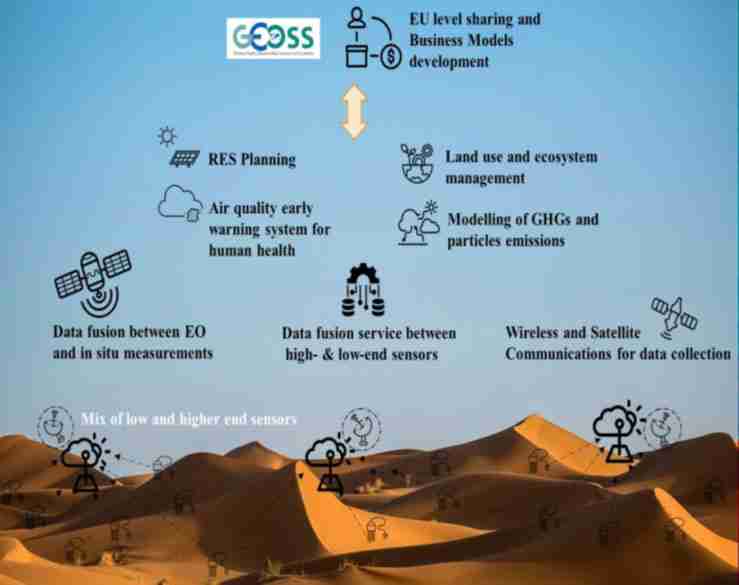
A series of services are developed, based on the needs of the local communities, as presented in Figure 1, namely:
| Services |
|---|
| Renewable Energy Systems planning |
| Air quality early-warning system for human health |
| Land use and ecosystem management |
| Modelling of Green House Gases and particles emissions |
CiROCCO will install the same sensing nodes and data collection equipment in all the areas covered, aiming to produce consistent time-series data in a standardised way.
The CiROCCO system will demonstrate how an extended network infrastructure (supplemented by LoRaWAN and satellite communicationss) can be used to transmit data from sensors in hard-to-reach areas to the central monitoring system.
Multiple nearby stations can be connected to WiFi, Bluetooth, Zigbee, LoraWAN networks, where an edge device aggregates data, pre-processes it and transmits (either raw or pre-processed) using 4G or radio waves depending on the network coverage, data to other existing platforms and monitoring services. To retrieve data from the edge device, the satellite Internet of Things network from consortium partners will be employed. All the data will be treated in the Stream Handler Platform offered by the consortium partners.
This platform provides the hooks for interconnecting, storing, transforming and processing data, as well as training, validating and executing Machine Learning and Deep Learning algorithms, resulting to a full Big Data solution with AI Capabilities.
It is a high-performance (low latency and high throughput) distributed streaming platform for handling real-time data based on Apache Kafka, and it can efficiently ingest and handle massive amounts of data into processing pipelines, for both real-time and batch processing. The Stream Handler Platform and its underlying technologies can support any type of data-intensive ICT services (Artificial Intelligence, Business Intelligence, etc.) from cloud to edge.
The selection of a suitable low-cost sensor that can actually capture the variability of the targeted environmental parameter is a crucial first link in the chain of validated sensor data generation. In the framework of CiROCCO, this decision is highly relevant for the air quality parameters. Particulate Matter (PM) is the main air quality output that corresponds to the design and objectives of the project. Given that the focus is placed on desert areas, it is consequential that coarse dust particles have to be measured, thus requiring the ability of the low-cost sensors to sample and quantify PM10 particles along with smaller size fractions (e.g., PM2.5). Coarse dust particles transported from desert areas are considered a major issue for the attainment of the EU PM10 standard, especially in Southern European countries, and there are specific provisions for the identification and exclusion of such events when assessing compliance.
However, regardless of regulatory issues, ambient dust exerts some impact on human health and major impacts on welfare, ecosystems and the climate, through various pathways. These impacts are expected to be magnified in near-desert areas, which frequently experience extreme ambient concentrations. CiROCCO aims at developing sophisticated calibration models that will extend between simple linear equations and advanced models incorporating physicochemical aerosol properties and AI models. In the framework of CiROCCO, the optimal approach for sensor calibration will be assessed in a pre-deployment calibration phase using advanced instrumentation for particle size distributions and atmospheric composition (including beta and optical reference-grade monitors, as well as aerosol mass spectrometry).
Rubio, C.;Lázaro, R.
Biologia - 2025 - DOI: 10.1007/s11756-024-01792-5
Álvarez, A.J.;Oliva, R.M.;Martínez-Valderrama, J.
Insects - 2025 - DOI: 10.3390/insects16030253
Grima-Olmedo, J.;Ballesteros-Navarro, B.;Pulido-Velazquez, D.;Renau-Pruñonosa, A.;Alcalá, F.J.;Llopis-Albert, C.;Jiménez-Gavilán, P.;Milkov-Ivanov, N.;Baena-Ruiz, L.;Grima-Olmedo, C.
Water (Switzerland) - 2023 - DOI: 10.3390/w15152728
Bullejos, M.;Cabezas, D.;Martín-Martín, M.;Alcalá, F.J.
Journal of Marine Science and Engineering - 2023 - DOI: 10.3390/jmse11010060
Ibáñez, J.;Gartzia, R.;Alcalá, F.J.;Martínez-Valderrama, J.
Land - 2022 - DOI: 10.3390/land11101626

29/6/2026
La calima no solo tiñe el cielo: también puede salinizar los acuíferos.
La calima no solo tiñe el cielo: también puede salinizar los acuíferos. Un equipo de investigación de la EEZA CSIC liderado por Francisco Alcalá ha demostrado que las partículas en suspensión transportadas por la calima aportan salinidad al agua subterránea, un hallazgo clave para comprender cómo estos episodios afectan a nuestros recursos hídricos. Este trabajo forma parte del proyecto CIROCCO, con siete estaciones de medición que analizan en detalle el impacto de los fenómenos atmosféricos sobre la calidad del agua en zonas áridas. Un paso más para entender cómo el clima moldea nuestro entorno y cómo nos podemos adaptar. Enlace a la noticia: https://www.canalsurmas.es/videos/detail/379929-noticias-1-almer%C3%ADa-viernes-26-de-junio-canal-sur #CSIC #EEZA #Calima #Acuíferos #AguaSubterranea #Salinidad #Ciencia #Investigación #MedioAmbiente #Divulgación #CIROCCO #Almería #CambioClimático

29/1/2026
Ya está operativo el proyecto CiROCCO en España.
Ya está operativo el proyecto CiROCCO en España. CiROCCO busca comprender y anticipar los episodios cada vez más frecuentes de polvo atmosférico en suspensión, aerosoles y partículas que llegan desde el norte de África y también de zonas desérticas locales. CiROCCO monitoriza variables ambientales mediante una metodología novedosa y establece las bases para elaborar modelos de predicción. CiROCCO ya ha completado su red operativa de muestreo en Egipto, Chipre, Serbia, y ahora también en España a través de la Estación Experimental de Zonas Áridas (EEZA-CSIC) que lidera la parte española, en dos áreas en Almería: Sierra de Gádor y Parque Natural Cabo de Gata-Níjar. La experimentación de CiROCCO guarda importantes sinergias con el proyecto Natural, proyecto coordinado (PID2024-158786NB-C21 y C22) de la EEZA-CSIC con la Universidad de Granada, que monitoriza y modela el balance de gases de efecto invernadero en estas dos áreas. Esta sinergia postula a la EEZA-CSIC como referente en la monitorización atmosférica y su repercusión sobre los recursos naturales y los ecosistemas en zonas áridas. (Grant nº 101086497, Programa HORIZON-CL6-2022-GOVERNANCE-01) https://ec.europa.eu/info/funding-tenders/opportunities/portal/screen/opportunities/horizon-results-platform/95043 @eeza_csic

31/1/2025
Entrevista a Francisco Javier Alcalá
Entrevista a Francisco Javier Alcalá, científico titular de la Estación Experimental de Zonas Áridas del CSIC por parte de Mabel Angulo ( @miangulo_95 ). La entrevista fue realizada en el programa ConCiencia de Canal Sur TV con motivo de su participación en el proyecto de investigación CIROCCO sobre el polvo sahariano. Puedes ver la entrevista completa en el siguiente enlace: https://www.youtube.com/watch?v=N6bhs_JRdNk #Eeza #csic #divulgacióncientífica #eezadivulga

6/4/2015
Renace la gran fauna del Sáhara
España reintroducirá en Mauritania el extinguido antílope mohor